Gutter Cleaning Naples FL: Cost, Timing and What a Good Job Includes
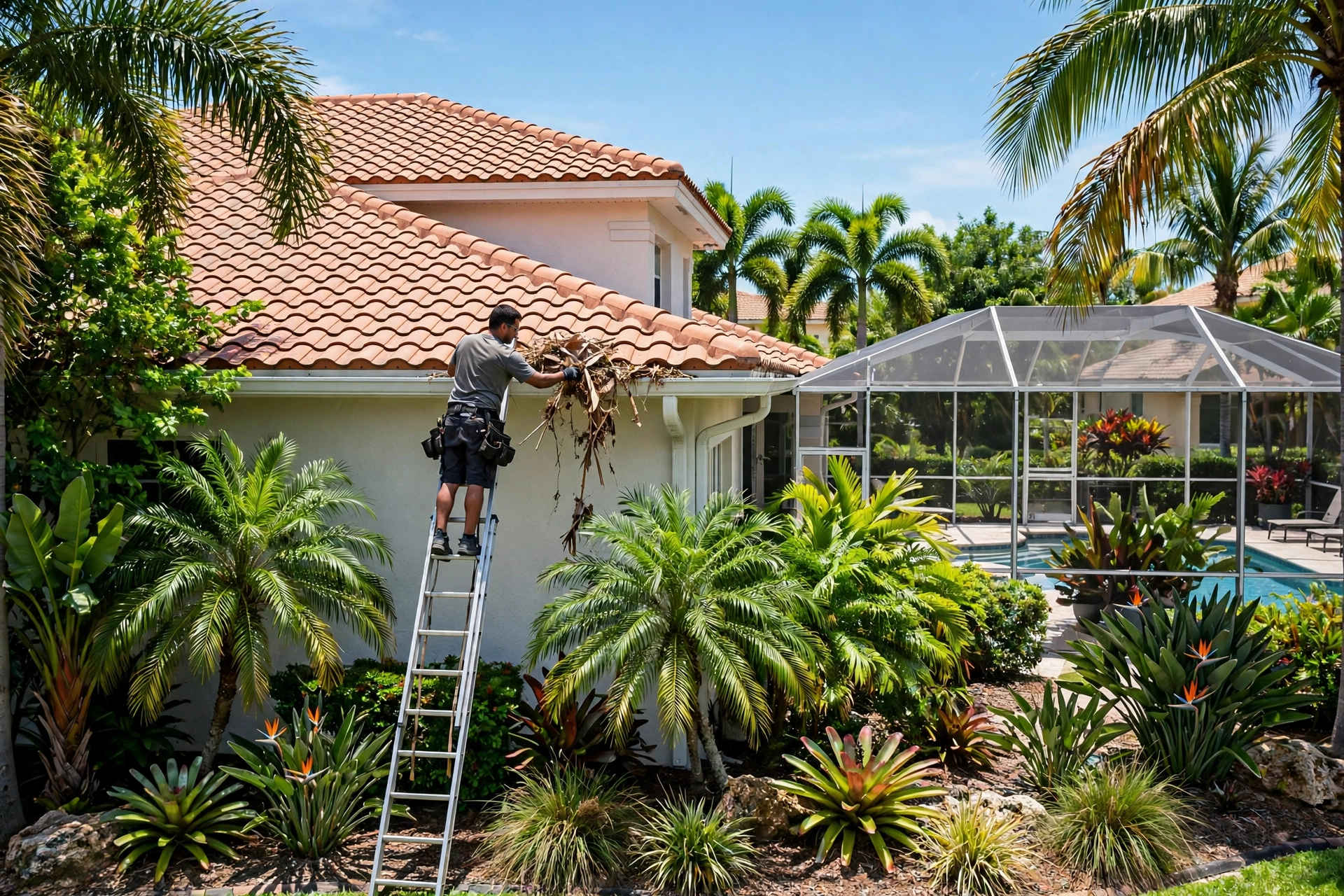
Gutter cleaning in Naples, FL means removing leaves, palm debris, grit and sediment from your gutters and downspouts so rainwater can drain away from the roof edge, walls and foundation. Most homes need it at least twice a year. Many online price guides put a typical single-visit job at roughly $115 to $225, but the actual quote depends on home height, gutter length and how clogged the system is.
This gutter cleaning Naples FL guide covers when to schedule cleaning in Southwest Florida, what affects the price, what a thorough visit includes, and how to choose someone you can trust on a ladder at your home.
Why Gutter Cleaning Matters in Naples
Naples gets heavy rain in short bursts. NOAA climate normals for the Naples area show roughly 50 inches of rain a year, with most of it falling in the wet months from June through September. Hurricane season runs from June 1 to November 30. When a gutter is packed with debris, that water has nowhere to go.
Overflowing gutters can send water down siding, soak the fascia boards behind the gutter, and pool next to the foundation or in landscaping beds. Pricing and service pages from local contractors describe the same pattern. Clogged gutters can overflow and damage siding, the foundation and landscaping, and regular cleaning helps the gutters last longer.
Naples homes also have conditions that make clogs more likely:
- Palm fronds, oak leaves and seed pods drop year-round, not just in autumn.
- Tile roofs shed grit and granules that settle in gutter bottoms and harden into sludge.
- Mature landscaping in many neighborhoods places trees close to rooflines.
- Storm debris can fill gutters in a single event, even in a home that was clean a month earlier.
Gutters are one part of how a roof sheds water. If you see staining, sagging or water marks near the roof edge, the gutter may not be the only problem. A roof inspection can tell you.
Clogged gutters also spill dirty water over the glass below. If your windows are streaked or spotted, our guide to exterior window cleaning in Naples, FL explains how they are cleaned and what it costs.
How Often Should You Clean Gutters in Naples, FL?
A common recommendation from the pages we reviewed is to clean gutters at least twice a year, with more frequent cleaning if you have many trees or wind that blows debris onto the roof. Because Naples has a defined wet season and a long storm season, timing matters as much as frequency.
A Practical Naples Gutter Calendar
| Time of year | Why it matters |
|---|---|
| Late spring (April–May) | Clear winter and spring debris before the rainy season begins in June. |
| After a named storm or heavy wind event | Storm-blown palm fronds and leaves can block downspouts fast. Check, even if you cleaned recently. |
| Early to mid fall (October–November) | Clear what accumulated over the wet season and the tail of hurricane season. |
| As needed | Homes under oaks or palms may need a third visit. |
This calendar is a practical suggestion built from local rainfall and storm-season dates, not a rule. Your yard, roof shape and tree cover set the real gutter cleaning Naples FL schedule.
Signs Your Gutters Need Attention Now
- Water spilling over the edge during rain
- Sagging or pulling-away sections
- Plants or seedlings growing in the gutter
- Staining or streaks on siding under the gutter line
- Standing water that stays in the gutter long after rain stops
- Water pooling near the foundation after storms
How Much Does Gutter Cleaning Cost in Naples?
Gutter cleaning Naples FL prices vary, and you should treat published ranges as a starting point, not a quote. Here is what three public sources reported when we reviewed them.
| Source (reviewed) | What it reported |
|---|---|
| HomeYou | A typical range of about $138 to $178, based on customer-reported data and a 215-linear-foot example |
| Angi | An average of about $153, with a typical range of about $116 to $222 and a wider spread of $60 to $300 |
| Today’s Homeowner | An average of around $0.81 per linear foot, assuming roughly 200 feet of gutter |
These figures come from third-party pages and may not match what a local company charges today. One of these pages also contained internal inconsistencies in how it labeled its unit pricing, which is a good reminder to treat any single number cautiously. No company offering the service in this article is bound to these figures.
What Moves the Price Up or Down
- Home height. A one-story home is simpler than a two- or three-story home that needs taller ladders or specialty equipment. One Angi listing described a three-story gutter that needed a boom truck.
- Total gutter length. More linear feet means more time.
- How clogged the gutters are. Compacted sludge from a long gap between cleanings takes longer than a light seasonal clear-out.
- Gutter size and condition. Larger systems, damaged sections and loose hangers add time or require repair.
- Gutter guards. Guards can reduce how often you need cleaning, but they still need maintenance.
- Downspout condition. A downspout blocked deep inside the run takes extra work to clear.
- Access. Pool cages, landscaping, steep slopes and tight spaces can slow the job.
A job that looks like a bargain deserves a second look. One local contractor page warns that unusually low bids can signal poor workmanship. A fair quote should be specific about what is and is not included.
What a Thorough Gutter Cleaning Includes
Not every visit is the same. Before you book, ask what the price covers. A complete job usually has these parts.
- Quick look before starting. The crew checks the gutter run, downspouts and any problem areas.
- Debris removal from gutters. Leaves, palm material, seed pods and grit come out by hand or with a vacuum or similar tool.
- Cleanup of what comes out. Debris should be bagged or removed, not left on the roof, lawn or pool deck.
- Downspout check. The crew confirms water moves freely from the gutter to the ground.
- Flushing with water. Running water through the system shows whether anything is still blocked, and whether seams leak.
- Notes on damage. Loose hangers, sagging sections or cracked seams should be reported, ideally with photos.
The service typically takes a few hours. One local guide says professional servicing usually takes about two to four hours, depending on home size and how much work is needed. DIY usually takes longer.
What Is Usually Not Included
Gutter cleaning does not normally cover gutter repair, replacement, guard installation, roof cleaning or roof repair. Ask whether the company does those jobs or whether you would need a separate contractor.
DIY vs. Hiring a Professional
Some homeowners handle single-story gutters themselves. Doing so is a real option, but the tradeoff is mostly about safety and time.
DIY can make sense when:
- The home is one story and the gutters are reachable from a stable ladder on level ground
- You are comfortable working at height
- Someone can spot you
Hiring a pro makes more sense when:
- The home is two stories or taller
- The roof is steep, tile or slick with moss or algae
- You have a pool cage, tight landscaping or uneven ground near the house
- You are not confident on a ladder
Ladders are a serious injury risk. Public safety sources such as OSHA, CDC and NIOSH publish ladder safety guidance, and it is worth reading before you climb. Never place a ladder on soft ground, never overreach, and do not work on a wet roof edge. If you have doubts, hire out.
Never walk on a tile roof to reach gutters. Tile can crack, and a damaged roof is a bigger problem than a clogged gutter.
Gutter Guards: Do They Replace Cleaning?
Gutter guards are designed to keep larger debris out. In Naples, where palm fronds, small leaves and tile grit are common, guards may reduce how much lands in the gutter, but they do not remove the need for maintenance. Fine debris can still collect on or under a guard, and a guard cannot fix a downspout that is clogged below.
One local contractor page says homes with guards may need clearing only about once every 12 months, but still need upkeep. Whether that holds for your home depends on the guard type and your trees. Ask any installer how the guard handles palm debris and how it is cleaned.
How to Choose a Gutter Cleaning Company in Naples
When you compare gutter cleaning Naples FL companies, look for signs a company is real, insured and straightforward.
- License and insurance. Ask what licensing and liability insurance the company carries for work at height, and verify it with the Florida licensing site rather than taking the answer at face value. Requirements can vary by the type of work, so ask what applies.
- A written quote. It should say what is included, how the price is set (flat fee, per foot or hourly) and what extra work costs.
- A clear scope. Ask whether downspouts are flushed, debris is hauled away, and photos are provided.
- Reviews you can read. Check Google, BBB and similar platforms for patterns, not one-off comments.
- Several quotes. Comparing a few helps you spot outliers.
- Respect for your property. Ask how they protect landscaping, pool areas and screens.
A reasonable company will answer these questions plainly and give you the details in writing.
Gutter Cleaning and Your Roof
Gutters sit at the lowest edge of your roof, so problems often show up together. Heavy debris can hold moisture against the roof edge. Black streaks, moss or granule loss on shingles or tile can wash into the gutter. If you are scheduling cleaning, it is a smart time to look for:
- Stains or dark streaks on the roof near the gutter line
- Loose, cracked or missing tiles or shingles
- Rotted or soft fascia boards
- Flashing that has pulled away
Catching a small issue early is usually cheaper than fixing water damage later.
FAQ
For gutter cleaning Naples FL, published estimates we reviewed range from roughly $60 to $300, with typical figures between about $115 and $225 for an average home. Your quote depends on height, gutter length, condition and access. Get a written estimate before work begins.
At least twice a year is the common recommendation. A good rhythm is late spring before the rainy season and early to mid fall. Add a check after major storms, and clean more often if you have palms or oaks near the roof.
Late spring, before the June rainy season, and again in fall. Spring and fall are also milder than the hottest summer weeks.
Professional work typically takes about two to four hours for an average home, according to one local guide. Larger or multi-story homes, or heavily clogged gutters, take longer.
No. Guards can reduce clogs, but they still need maintenance, and fine debris can collect on or under them.
Yes. Overflow can affect siding, fascia, landscaping and the soil near the foundation, and standing water can speed up wear on the gutter itself.
It can be on a single-story home with stable footing, but ladder falls are a real risk. If the home is tall, the roof is tile or steep, or you are unsure, hire a professional.
It is a smart step. Clear gutters and downspouts help water drain during heavy rain, and checking them early gives you time to repair loose or damaged sections.
Next Steps
Clean gutters protect the roof edge, siding, landscaping and the ground around your home, and in Naples the heavy summer rains make timely cleaning worth planning ahead. If you are unsure whether your gutters, or the roof above them, need attention, start with an inspection and a written scope.
Ready to schedule gutter cleaning in Naples, FL? Contact Naples Pressure Cleaning at +1 (239) 422-9648 or by email at info@naplesflpressurecleaning.com to request a written estimate.
Pressure Washing vs Soft Washing: What Naples Homes Actually Need
If you’ve started researching exterior cleaning for your Naples home, you’ve probably noticed that “pressure washing” and “soft washing” get used almost interchangeably by homeowners — but they’re not the same service, and using the wrong one on the wrong surface can cause real damage. A concrete driveway can handle forceful, high-pressure cleaning. A tile roof or painted stucco wall generally can’t. Get that mismatched, and you’re looking at stripped roof granules, water forced behind siding, or etched surfaces that never look quite right again.
Learn more about Naples Pressure Cleaning →
This guide breaks down what each method actually does, which one belongs on which part of a Naples home, and why Southwest Florida’s humidity, coastal air, and near-constant biological growth make this decision more consequential here than it would be in a drier climate. By the end, you’ll know exactly which method fits your roof, siding, driveway, pavers, and screened lanai — and when it’s worth bringing in a professional instead of tackling it yourself.
| Surface | Recommended Method |
|---|---|
| Asphalt shingle & tile roofs | Soft Washing |
| Siding & painted stucco | Soft Washing |
| Driveways, pavers & pool decks | Pressure Washing |
| Screened lanai & pool cage screening | Soft Washing |
Pressure Washing and Soft Washing Aren’t the Same Service
The core difference comes down to what’s actually doing the cleaning: force or chemistry.
Pressure washing (sometimes called power washing) uses a high-pressure stream of water — typically somewhere in the 1,300 to 3,000+ PSI range — to physically blast dirt, grime, oxidation, and algae off a surface. The water itself is doing almost all the work. It’s fast, effective on tough, durable surfaces, and doesn’t rely much on cleaning chemicals.
Soft washing uses the opposite approach. It applies a low-pressure spray — usually under 500 PSI — combined with a biodegradable cleaning solution, often chlorine- or surfactant-based. The solution is left to sit on the surface for several minutes so it can break down organic growth like algae, mold, and mildew at the root, and it’s then rinsed away with a gentle, low-pressure rinse rather than blasted off.
That distinction matters more than it sounds. Pressure washing physically removes what’s sitting on top of a surface. Soft washing kills the organism causing the problem in the first place. On a driveway covered in loose dirt, that difference is mostly academic — you just want the grime gone. But on a roof covered in algae, it’s the difference between a clean that lasts and a clean that’s back to looking dingy within a few months, because pressure alone often leaves the root of the growth intact.
So Which One Is “Better”?
Neither method is universally better — the right choice depends on the surface you’re cleaning, what’s growing or building up on it, and its overall condition. A driveway and a tile roof have almost nothing in common structurally, and treating them the same way is where most exterior-cleaning damage actually happens. The rest of this guide walks through that decision surface by surface.
Why This Decision Matters More in Naples
Southwest Florida’s climate isn’t incidental to this topic — it’s a big part of why the method you choose actually matters here. Naples sits in a subtropical, coastal environment with high year-round humidity and a pronounced wet season, both of which create ideal conditions for algae, mold, and mildew to take hold on exterior surfaces. Shaded areas under mature landscaping, north-facing walls, and roof sections that stay damp longer all tend to develop biological growth faster than they would in a drier inland climate.
Add in coastal and Gulf-adjacent exposure, which is common across much of Naples, and you get an additional layer of airborne salt residue settling on hard surfaces — one more reason exteriors here tend to need attention more often than in less humid parts of the country. Hurricane season, roughly June through November, compounds this further, leaving behind organic debris and storm residue that often calls for a post-storm cleaning pass.
Why does my Naples home get algae and black streaks so quickly?
In short: heat, humidity, and shade create a near-constant environment for biological growth, and coastal moisture keeps surfaces damp longer than they would stay in a drier climate. That’s also why a cleaning method that only removes visible growth — without addressing what’s causing it — tends to underperform here compared to regions where regrowth is slower.
This is also why soft washing shows up so consistently in Florida-market exterior cleaning discussions specifically for roofs and siding, while pressure washing remains the default for concrete and pavers. It’s not a marketing preference — it’s a response to how fast this climate lets organic growth return.
Roofs: Why Soft Washing Is the Standard Recommendation
If there’s one surface where the wrong method causes the most damage, it’s the roof.
Black streaking on asphalt shingle roofs is typically caused by a bacteria called gloeocapsa magma, which feeds on the limestone filler in shingles. It’s extremely common across Florida roofs and is often mistaken for simple dirt. High-pressure washing can remove the visible streaking, but it also strips away the protective granules that shield shingles from UV damage — shortening the roof’s usable life in the process. This isn’t a minor concern: the Asphalt Roofing Manufacturers Association (ARMA) specifically recommends low-pressure, detergent- or bleach-assisted washing as the preferred method for cleaning asphalt shingle roofs, precisely to avoid this kind of granule loss.
Tile roofs, common throughout Naples, carry a similar risk — high pressure can crack tiles, dislodge them, or wear down protective glazing over time.
Can you pressure wash a roof?
Technically, yes — but for asphalt shingle and tile roofs, it’s generally not recommended. Soft washing is the standard approach because it removes algae and black streaks without stripping granules or risking tile damage, and because it treats the biological growth causing the staining rather than just blasting away what’s currently visible.
Siding and Stucco: Where High Pressure Goes Wrong
Naples homes are predominantly stucco, with some vinyl and wood siding mixed in depending on the neighborhood and build era. All three respond poorly to high-pressure cleaning, just for different reasons.
On vinyl and wood siding, high-pressure water can force its way behind panels and seams. Once trapped there, that moisture doesn’t just evaporate — it becomes the starting point for hidden mold growth inside the wall assembly, which is a far more expensive problem than the algae you were trying to remove in the first place.
Stucco carries a different risk. It’s porous, and it can be pitted or etched by concentrated high-pressure spray, especially at close range. Painted stucco adds another layer of caution: certain paint pigments, particularly reds, blues, greens, and oranges, can react with the sodium hypochlorite used in some soft-washing solutions. It’s a lesser-known risk, but a real one — which is why a professional soft-wash technician will typically test an inconspicuous spot before treating a full painted wall.
Is it safe to pressure wash stucco?
Not usually, at full pressure. Soft washing is the safer standard for stucco and painted siding because it cleans through chemical action rather than force, avoiding the etching and moisture-intrusion risks that come with high-pressure water on these surfaces.
Driveways, Pavers, and Pool Decks: Where Pressure Washing Earns Its Reputation
This is the flip side of the roof-and-siding conversation. Concrete driveways, sidewalks, and pool decks are dense, durable, and largely non-porous compared to roofing or painted surfaces — which is exactly why they can handle, and often need, the higher pressure that would damage a roof or a wall. Ground-in dirt, oil stains, rust marks, and tannin staining from surrounding landscaping typically require more mechanical force than a low-pressure rinse can provide.
Pavers deserve a slightly more careful approach than plain concrete. They’re durable, but the joints between them are filled with sand, and pressure that’s too aggressive — or held too close for too long — can blow that sand out, which affects the paver’s structural stability and appearance over time. A wide fan-tip nozzle held at a proper distance, rather than a narrow, concentrated stream, is generally the safer approach for pavers.
Can you pressure wash pavers without damaging them?
Yes, if it’s done correctly — with an appropriately wide spray pattern, reasonable distance from the surface, and attention to the joint sand. Done carelessly, it’s one of the more common ways homeowners end up needing paver re-sanding sooner than expected.
Screened Lanais and Pool Cages: A Naples-Specific Surface
Screened lanais and pool cages are a defining feature of Naples homes, and they don’t get nearly the attention in most exterior-cleaning guides that roofs and driveways do — which is a real gap, considering how common they are here.
Screening is thin, and it’s easy to tear or blow out with high-pressure water aimed directly at it. The aluminum framing can typically tolerate more pressure than the screen itself, but the screen mesh is the limiting factor. Soft washing, or a very low-pressure rinse combined with a mild cleaning solution, is generally the safer approach for the screen panels themselves, while the aluminum frame, cage decking, and any concrete pool deck within the enclosure can usually be treated the same way you’d treat similar surfaces elsewhere on the property.
Can you pressure wash a screened lanai or pool cage?
The frame and decking generally can be, within reason, but the screen material itself is better cleaned with low pressure and a mild solution to avoid tearing or warping the mesh.
What Happens When the Wrong Method Gets Used
It’s worth being direct about the actual risks, because this is where most of the regret happens after a cleaning job:
- Stripped roof granules from high-pressure washing on asphalt shingles, shortening roof lifespan and voiding some manufacturer warranties
- Water forced behind siding or stucco, leading to trapped moisture and hidden mold growth
- Etched or pitted stucco and painted surfaces from concentrated high-pressure spray
- Torn or warped screen panels on lanais and pool cages
- Blown-out paver joint sand, affecting paver stability over time
- Damaged window seals or screens from pressure aimed too directly at these components
None of this means pressure washing is inherently risky — it’s an appropriate, effective method for the surfaces it’s suited to. The risk comes specifically from applying it to surfaces built for a gentler approach.
How Often Should Naples Homes Be Cleaned?
There’s no single number that applies to every property, since it depends heavily on shade, landscaping, proximity to the coast, and how quickly a specific home tends to develop growth. That said, Southwest Florida’s humidity and wet season generally mean exteriors here accumulate algae, mildew, and grime faster than homes in drier climates — which is why many Florida homeowners find that annual or semi-annual cleaning keeps buildup manageable, rather than waiting until staining is heavy and harder to remove.
Post-hurricane-season cleaning is also worth considering as a practical checkpoint for many Naples properties, since storm debris and extended wet conditions during hurricane season can accelerate buildup on roofs and siding.
Does regular cleaning actually extend the life of a roof or siding?
In a general sense, yes — because algae, mold, and trapped organic material can gradually degrade roofing materials and painted surfaces over time if left untreated, regular cleaning that addresses growth (rather than just its visible symptoms) helps limit that slow deterioration.
What Affects the Cost of Exterior Cleaning
Naples-specific pricing varies enough by provider and project that it’s not useful to quote a single number here — but the factors that drive cost are consistent across the industry:
- Square footage of the surfaces being cleaned
- Number of surfaces included — a roof-and-siding package costs more than a driveway alone
- Condition and severity of buildup — heavier algae or long-neglected surfaces take more time and product
- Accessibility — multi-story homes, steep roof pitches, or gated-community access can affect labor time
- Method required — soft washing typically involves specialized cleaning solution in addition to labor, which can factor into pricing differently than a straightforward pressure wash
- One-time deep clean vs. a maintenance schedule — ongoing cleaning plans are often priced differently than a single heavy-duty job
If you’re comparing quotes, it’s worth asking specifically which method a company plans to use on each surface, rather than assuming “pressure washing” is being offered as a catch-all term — since in casual conversation, homeowners and even some providers use “pressure washing” loosely to describe exterior cleaning in general, even when soft washing is actually what’s being performed.
Can You DIY This, or Should You Call a Professional?
Renting or buying a consumer-grade pressure washer for a driveway or patio is common, and reasonably low-risk if you’re careful with distance, angle, and nozzle selection. Concrete and pavers are forgiving enough that a homeowner willing to read the equipment manual can usually get acceptable results.
Roofs, painted stucco, siding, and screened enclosures are a different story. These are the surfaces where mismatched pressure or the wrong chemical solution cause the most expensive mistakes — and where soft washing’s chemical dilution and dwell-time requirements make it harder to get right without experience. If you’re dealing with a roof, painted exterior walls, or lanai screening, that’s generally where professional soft-washing expertise is worth the cost, both for the quality of the result and for avoiding damage that costs more to fix than the cleaning job itself.
A reasonable way to think about it: if a mistake would mean re-caulking, re-screening, or replacing damaged material, it’s worth having someone experienced handle it. If a mistake just means the driveway isn’t perfectly clean on the first pass, DIY is a lower-stakes place to start.
How to Tell If a Contractor Is Using the Right Method
Since “pressure washing” gets used as a catch-all term, it’s worth asking a potential provider a few direct questions before hiring:
- Which method do you plan to use on my roof, and which on my siding or driveway?
- Do you soft wash biologically active surfaces, or is everything treated with high pressure?
- How do you protect landscaping, screens, and painted surfaces during the job?
A provider offering both pressure washing and soft washing — and explaining why they’d use one over the other for your specific surfaces — is generally a stronger signal than one that treats every job the same way regardless of what’s being cleaned. The surface-by-surface reasoning above is exactly the kind of explanation a knowledgeable provider should be able to walk you through before they start.
Choosing the Right Method Comes Down to the Surface, Not a Universal Answer
The most useful way to think about pressure washing versus soft washing isn’t “which one is better” — it’s “which one is right for this specific surface, in this specific condition, in a climate like Naples’.” Hard, durable surfaces like driveways and pavers are generally well-suited to pressure washing’s mechanical force. Roofs, painted stucco, siding, and screened enclosures are better matched to soft washing’s gentler, chemical-based approach — particularly in a climate where algae and mildew regrow quickly enough that removing the visible symptom without addressing the underlying growth rarely holds up for long.
If you’re weighing this decision for your own home and want a second opinion on which method fits which surface — or you’re ready to have a professional evaluate your roof, siding, driveway, or lanai — a qualified Naples pressure washing and soft washing provider can walk your property, identify what each surface actually needs, and explain the reasoning before any work begins.
Frequently Asked Questions
Soft-washing solutions are typically biodegradable, but runoff should still be rinsed away from plants and controlled during application. A professional job usually includes pre-wetting or covering sensitive landscaping before treatment.
It can be, since it often involves specialized cleaning solution in addition to labor — but pricing varies by provider and project scope, so it’s worth getting a direct comparison for your specific home rather than assuming a fixed cost difference.
Many homeowners schedule cleaning during the drier season for more predictable results, or shortly after hurricane season to address storm-related buildup — though exterior cleaning can generally be done year-round depending on the provider’s scheduling.