Exterior Window Cleaning in Naples, FL: Cost, Frequency and What to Expect
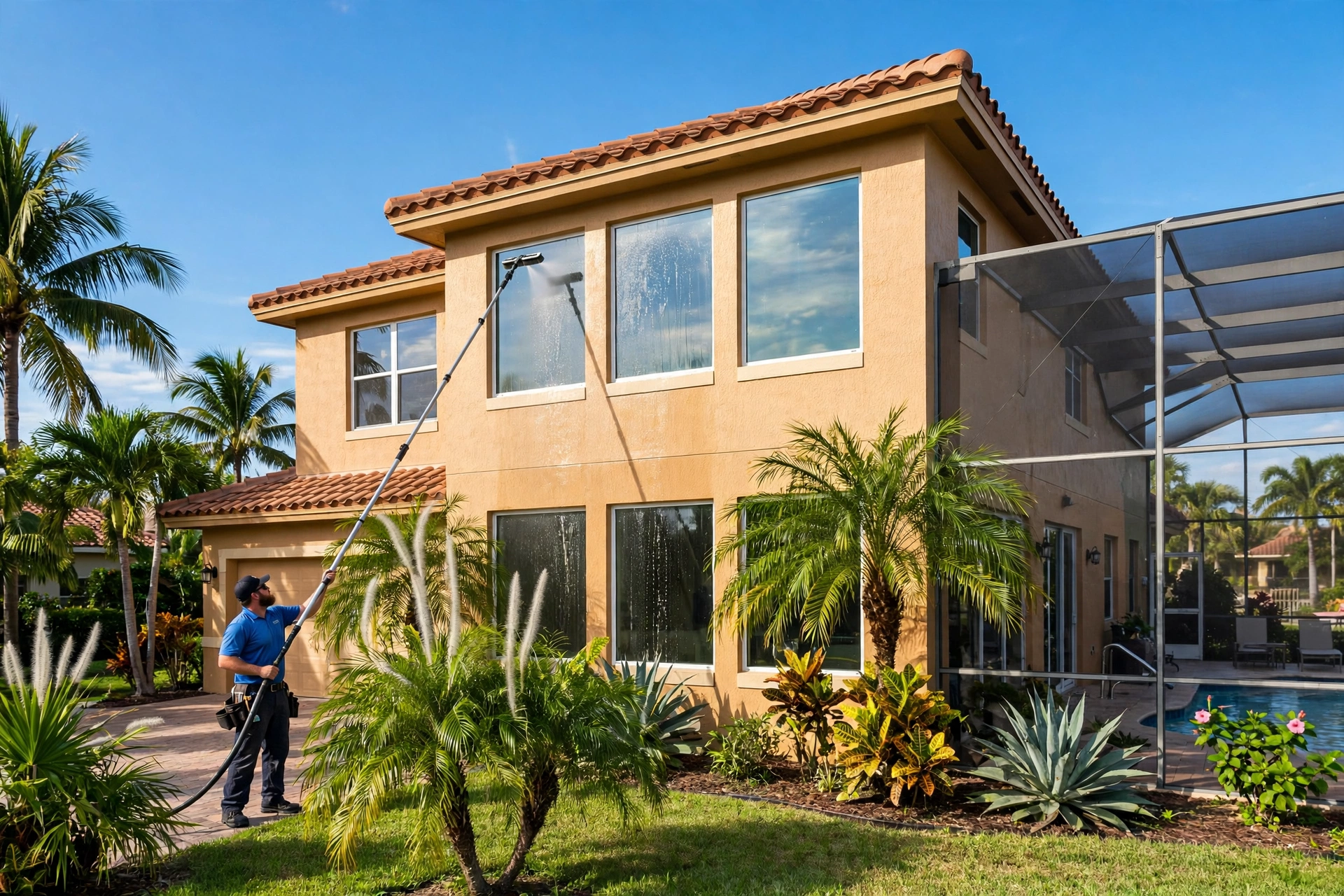
Exterior window cleaning in Naples, FL means removing dirt, salt film, pollen, water spots and mineral deposits from the outside of your glass, usually along with frames and sills. Most homes do well with a professional visit two to four times a year, and homes close to the water often need it more. Public price guides put a typical Naples job at roughly $100 to $400, depending on window count, height and condition.
This exterior window cleaning Naples FL guide explains what makes Southwest Florida windows dirty so fast, how often to clean them, what affects a quote, how professionals work, and what to ask before you book.
Why Windows Get Dirty So Quickly in Naples
Naples homes deal with a mix of conditions that other parts of the country do not. Some of the main causes are:
- Salt in the air. Homes near the Gulf, bays or canals can collect a fine salt film. Local contractors describe it as a sticky layer that holds onto dust and moisture.
- Heavy summer rain and humidity. Rain splashes dirt onto glass and leaves spots as it dries. NOAA normals for the Naples area show most of the year’s rain arrives from June through September.
- Pollen and dust. Seasonal pollen and Saharan dust events can settle on glass, screens and sills.
- Insects. Contractors in the region report lovebug residue in late spring and early fall, and it can stick to glass if left on.
- Sprinkler overspray. Irrigation water in many parts of Florida carries minerals. When it dries on glass it leaves white spots that ordinary glass cleaner may not remove.
- Storm debris. Wind-driven leaves, palm material and grit can coat windows after a tropical system. Hurricane season runs June 1 to November 30.
Some of these points come from contractor pages and are general regional observations, not measured data for your street. A home on a Gulf-side lot will usually see more salt than one farther inland.
Overflowing gutters add to it, dumping dirty water down the glass and frames every time it rains. If that is happening at your home, our guide to gutter cleaning in Naples, FL covers the fix.
How Often Should You Clean Exterior Windows in Naples?
There is no single correct schedule. Local contractors give a range, and your home’s exposure should set the pace.
| Situation | Typical approach |
|---|---|
| Inland home with light tree cover | Two to three times a year |
| Home with pool cage, heavy landscaping or sprinklers hitting glass | Three to four times a year |
| Waterfront or canal-front property | More often, such as every few months |
| Commercial storefront with foot traffic | Monthly may be reasonable |
One Naples window-cleaning franchise page says its two most popular exterior schedules are every three months and every six months. A Cape Coral contractor suggests two to three cleanings a year for most Southwest Florida homes and more frequent visits within a mile of the water, while also noting that monthly service usually isn’t worth it for a typical homeowner. Treat those figures as one company’s view, not a rule. They agree on the main point, though: closer to salt water means more frequent cleaning.
Signs It Is Time to Book
- A hazy or cloudy look when the sun hits the glass
- White spots or rings that do not wipe away
- Salt residue on the lower panes or frames
- Cobwebs, insect residue and dirt buildup on sills and tracks
- Windows that look streaky after rain
- A view that has simply dulled
Cleaning before spots turn into mineral buildup keeps the job easier and the glass in better condition.
How Much Does Exterior Window Cleaning Cost in Naples?
Exterior window cleaning Naples FL prices differ by company, and published guides rely on customer-reported or modeled data. Here is what we found when we reviewed two public sources.
| Source | What it reported |
|---|---|
| HomeYou (customer-reported quotes) | Typical range of about $94 to $380, with a typical job around $200 and small jobs starting near $94 |
| Angi | Average of about $195, typical range of about $132 to $258, and an overall spread of $100 to $400 |
These are third-party figures, not prices from any specific business. They will not match every quote, and neither page gives a full explanation of how its numbers were built. Use them only as a rough check on whether a quote is in the right area.
What Changes the Price
- Number and size of windows. Pricing is often by window count or by glass square footage, depending on the company.
- Home height. Second-story and higher windows take more time and may need special equipment.
- Access. Pool cages, landscaping and tight spaces can slow the work.
- Condition of the glass. Hard water deposits or heavy salt buildup take more time than light dust.
- Screens, tracks and sills. Some companies include them, and others charge extra.
- Exterior only or inside and out. Ask exactly which sides are included.
- Frequency. Some companies offer lower rates on recurring plans. One Naples franchise page advertises savings of up to 20% on annual plans, though you should confirm terms directly.
Get a written quote that lists what is and is not covered.
How Professionals Clean Exterior Windows
Methods vary, but most professional crews follow a similar sequence.
- Inspect the windows. The crew looks at the glass, frames, screens and seals before starting.
- Loosen the dirt. Glass is scrubbed with a cleaning solution and a brush, scrubber or washing tool. Heavier buildup may get repeated passes.
- Rinse or squeegee. The dirty water is removed with a squeegee or a rinse. Many crews use water-fed poles with purified water. Pure water dries without leaving mineral spots.
- Wipe frames and sills. Edges, frames and sills are wiped so runoff does not streak the glass later.
- Final check. The crew looks at the glass from several angles in the light.
Squeegee vs. Water-Fed Pole
A squeegee gives close control on reachable glass. A water-fed pole lets a technician reach higher windows from the ground, and purified water helps the glass dry clear. Neither method is automatically better. The right choice depends on height, access and how dirty the glass is.
What Not to Use
Be cautious with high-pressure washing near windows. Strong pressure can force water past seals or damage screens and frames. Ask any company how they handle pressure and what they use around impact-rated windows. Check your window manufacturer’s care guidance if you have it, because it can differ by product.
Hard Water Spots: A Common Naples Problem
Mineral deposits are a frequent reason homeowners call a professional. They form when water containing dissolved minerals dries on glass. Sprinkler overspray is a common source, and rain can also leave residue.
A few points to know:
- Fresh spots are easier to remove than spots that have baked in for months.
- Standard glass cleaner may not work on mineral deposits, and some specialized products need care.
- Scratching is a real risk. Do not use abrasive tools or blades on glass without knowing the coating and the correct technique.
- Prevention helps. Aim sprinklers away from windows and ask about a schedule that clears deposits before they set.
- Heavy etching can be permanent. If spots do not come off with gentle cleaning, call a professional rather than escalating to harsher methods.
DIY or Professional Window Cleaning?
Many people clean ground-floor windows themselves. That works when the glass is within easy reach and spotting is light.
DIY can work when:
- Windows are on the ground floor
- Dirt is light and recent
- You have the time and the right tools
Hire a professional when:
- You have upper-story windows or hard-to-reach glass
- Hard water or salt buildup is heavy
- You want a recurring schedule
- Ladder work is a safety concern
Ladders cause real injuries, and safety agencies such as OSHA and the CDC publish ladder guidance worth reading before you climb. A professional with proper equipment can reduce that risk.
Hurricane Season and Window Care
Windows take a beating in storm season. Salt spray and debris can leave heavy residue, and hardware can stick or corrode over time. After a major storm, rinse off salt and check tracks, seals and screens. Wait for safe conditions before cleaning, and do not climb onto wet surfaces or work near downed lines.
If you have impact-rated windows, follow the manufacturer’s care instructions and ask any cleaner how they protect the seals and frames. Cleaning windows regularly also helps you notice cracked seals or other damage early.
How to Choose a Window Cleaner in Naples
When you compare exterior window cleaning Naples FL companies, ask these questions before you book.
- Insurance. Ask whether the company carries liability insurance and workers’ compensation where applicable, and ask for proof.
- Written scope. The quote should say what is cleaned: glass, screens, tracks and sills.
- Method. Ask whether they use squeegees, water-fed poles or both, and how they handle mineral spots.
- Access. Ask how they handle upper-story windows, pool cages and landscaping.
- Reviews. Look for patterns across Google, Thumbtack and BBB rather than one comment.
- Recurring plans. If you want regular service, ask how scheduling works and how to change it.
- Clear answers. A good company explains what it does and does not do.
Request two or three quotes so you can compare scope and price, not just the final number.
FAQ
For exterior window cleaning Naples FL, public guides reviewed put typical Naples jobs between roughly $100 and $400, with averages near $195 to $200. Your price depends on the number of windows, height, access and glass condition. Get a written quote before work starts.
Two to four times a year works for many homes. Waterfront and canal-front homes, or those with sprinkler overspray, often need more frequent service.
Many homeowners schedule a cleaning after the rainy season and again before or during the dry winter months. A post-storm rinse also helps remove salt and debris.
White spots are usually mineral deposits from sprinkler water or rain that dried on the glass. Fresh spots are easier to remove, and older ones may need professional treatment.
Not always. Some companies include them and others charge extra. Ask when you request your quote.
Rain can leave spots and make it hard to judge results, so most companies reschedule in heavy rain. Ask how your provider handles weather delays.
High pressure can damage seals, screens and frames. Ask how the company cleans glass and what they use around sensitive areas.
Rinse off salt and debris once conditions are safe, then check seals, tracks and screens. A thorough cleaning can follow when the weather settles.
Next Steps
Salt, humidity, sprinklers and storms mean Naples windows rarely stay clean for long. A regular schedule, a clear written quote and attention to hard water spots will keep the glass in better shape. If you are comparing options for exterior window cleaning Naples FL services, start with a few quotes and ask each company exactly what is included.
Want a quote for exterior window cleaning in Naples, FL? Contact Naples Pressure Cleaning at +1 (239) 422-9648 or by email at info@naplesflpressurecleaning.com to request a written estimate.
Pressure Washing vs Soft Washing: What Naples Homes Actually Need
If you’ve started researching exterior cleaning for your Naples home, you’ve probably noticed that “pressure washing” and “soft washing” get used almost interchangeably by homeowners — but they’re not the same service, and using the wrong one on the wrong surface can cause real damage. A concrete driveway can handle forceful, high-pressure cleaning. A tile roof or painted stucco wall generally can’t. Get that mismatched, and you’re looking at stripped roof granules, water forced behind siding, or etched surfaces that never look quite right again.
Learn more about Naples Pressure Cleaning →
This guide breaks down what each method actually does, which one belongs on which part of a Naples home, and why Southwest Florida’s humidity, coastal air, and near-constant biological growth make this decision more consequential here than it would be in a drier climate. By the end, you’ll know exactly which method fits your roof, siding, driveway, pavers, and screened lanai — and when it’s worth bringing in a professional instead of tackling it yourself.
| Surface | Recommended Method |
|---|---|
| Asphalt shingle & tile roofs | Soft Washing |
| Siding & painted stucco | Soft Washing |
| Driveways, pavers & pool decks | Pressure Washing |
| Screened lanai & pool cage screening | Soft Washing |
Pressure Washing and Soft Washing Aren’t the Same Service
The core difference comes down to what’s actually doing the cleaning: force or chemistry.
Pressure washing (sometimes called power washing) uses a high-pressure stream of water — typically somewhere in the 1,300 to 3,000+ PSI range — to physically blast dirt, grime, oxidation, and algae off a surface. The water itself is doing almost all the work. It’s fast, effective on tough, durable surfaces, and doesn’t rely much on cleaning chemicals.
Soft washing uses the opposite approach. It applies a low-pressure spray — usually under 500 PSI — combined with a biodegradable cleaning solution, often chlorine- or surfactant-based. The solution is left to sit on the surface for several minutes so it can break down organic growth like algae, mold, and mildew at the root, and it’s then rinsed away with a gentle, low-pressure rinse rather than blasted off.
That distinction matters more than it sounds. Pressure washing physically removes what’s sitting on top of a surface. Soft washing kills the organism causing the problem in the first place. On a driveway covered in loose dirt, that difference is mostly academic — you just want the grime gone. But on a roof covered in algae, it’s the difference between a clean that lasts and a clean that’s back to looking dingy within a few months, because pressure alone often leaves the root of the growth intact.
So Which One Is “Better”?
Neither method is universally better — the right choice depends on the surface you’re cleaning, what’s growing or building up on it, and its overall condition. A driveway and a tile roof have almost nothing in common structurally, and treating them the same way is where most exterior-cleaning damage actually happens. The rest of this guide walks through that decision surface by surface.
Why This Decision Matters More in Naples
Southwest Florida’s climate isn’t incidental to this topic — it’s a big part of why the method you choose actually matters here. Naples sits in a subtropical, coastal environment with high year-round humidity and a pronounced wet season, both of which create ideal conditions for algae, mold, and mildew to take hold on exterior surfaces. Shaded areas under mature landscaping, north-facing walls, and roof sections that stay damp longer all tend to develop biological growth faster than they would in a drier inland climate.
Add in coastal and Gulf-adjacent exposure, which is common across much of Naples, and you get an additional layer of airborne salt residue settling on hard surfaces — one more reason exteriors here tend to need attention more often than in less humid parts of the country. Hurricane season, roughly June through November, compounds this further, leaving behind organic debris and storm residue that often calls for a post-storm cleaning pass.
Why does my Naples home get algae and black streaks so quickly?
In short: heat, humidity, and shade create a near-constant environment for biological growth, and coastal moisture keeps surfaces damp longer than they would stay in a drier climate. That’s also why a cleaning method that only removes visible growth — without addressing what’s causing it — tends to underperform here compared to regions where regrowth is slower.
This is also why soft washing shows up so consistently in Florida-market exterior cleaning discussions specifically for roofs and siding, while pressure washing remains the default for concrete and pavers. It’s not a marketing preference — it’s a response to how fast this climate lets organic growth return.
Roofs: Why Soft Washing Is the Standard Recommendation
If there’s one surface where the wrong method causes the most damage, it’s the roof.
Black streaking on asphalt shingle roofs is typically caused by a bacteria called gloeocapsa magma, which feeds on the limestone filler in shingles. It’s extremely common across Florida roofs and is often mistaken for simple dirt. High-pressure washing can remove the visible streaking, but it also strips away the protective granules that shield shingles from UV damage — shortening the roof’s usable life in the process. This isn’t a minor concern: the Asphalt Roofing Manufacturers Association (ARMA) specifically recommends low-pressure, detergent- or bleach-assisted washing as the preferred method for cleaning asphalt shingle roofs, precisely to avoid this kind of granule loss.
Tile roofs, common throughout Naples, carry a similar risk — high pressure can crack tiles, dislodge them, or wear down protective glazing over time.
Can you pressure wash a roof?
Technically, yes — but for asphalt shingle and tile roofs, it’s generally not recommended. Soft washing is the standard approach because it removes algae and black streaks without stripping granules or risking tile damage, and because it treats the biological growth causing the staining rather than just blasting away what’s currently visible.
Siding and Stucco: Where High Pressure Goes Wrong
Naples homes are predominantly stucco, with some vinyl and wood siding mixed in depending on the neighborhood and build era. All three respond poorly to high-pressure cleaning, just for different reasons.
On vinyl and wood siding, high-pressure water can force its way behind panels and seams. Once trapped there, that moisture doesn’t just evaporate — it becomes the starting point for hidden mold growth inside the wall assembly, which is a far more expensive problem than the algae you were trying to remove in the first place.
Stucco carries a different risk. It’s porous, and it can be pitted or etched by concentrated high-pressure spray, especially at close range. Painted stucco adds another layer of caution: certain paint pigments, particularly reds, blues, greens, and oranges, can react with the sodium hypochlorite used in some soft-washing solutions. It’s a lesser-known risk, but a real one — which is why a professional soft-wash technician will typically test an inconspicuous spot before treating a full painted wall.
Is it safe to pressure wash stucco?
Not usually, at full pressure. Soft washing is the safer standard for stucco and painted siding because it cleans through chemical action rather than force, avoiding the etching and moisture-intrusion risks that come with high-pressure water on these surfaces.
Driveways, Pavers, and Pool Decks: Where Pressure Washing Earns Its Reputation
This is the flip side of the roof-and-siding conversation. Concrete driveways, sidewalks, and pool decks are dense, durable, and largely non-porous compared to roofing or painted surfaces — which is exactly why they can handle, and often need, the higher pressure that would damage a roof or a wall. Ground-in dirt, oil stains, rust marks, and tannin staining from surrounding landscaping typically require more mechanical force than a low-pressure rinse can provide.
Pavers deserve a slightly more careful approach than plain concrete. They’re durable, but the joints between them are filled with sand, and pressure that’s too aggressive — or held too close for too long — can blow that sand out, which affects the paver’s structural stability and appearance over time. A wide fan-tip nozzle held at a proper distance, rather than a narrow, concentrated stream, is generally the safer approach for pavers.
Can you pressure wash pavers without damaging them?
Yes, if it’s done correctly — with an appropriately wide spray pattern, reasonable distance from the surface, and attention to the joint sand. Done carelessly, it’s one of the more common ways homeowners end up needing paver re-sanding sooner than expected.
Screened Lanais and Pool Cages: A Naples-Specific Surface
Screened lanais and pool cages are a defining feature of Naples homes, and they don’t get nearly the attention in most exterior-cleaning guides that roofs and driveways do — which is a real gap, considering how common they are here.
Screening is thin, and it’s easy to tear or blow out with high-pressure water aimed directly at it. The aluminum framing can typically tolerate more pressure than the screen itself, but the screen mesh is the limiting factor. Soft washing, or a very low-pressure rinse combined with a mild cleaning solution, is generally the safer approach for the screen panels themselves, while the aluminum frame, cage decking, and any concrete pool deck within the enclosure can usually be treated the same way you’d treat similar surfaces elsewhere on the property.
Can you pressure wash a screened lanai or pool cage?
The frame and decking generally can be, within reason, but the screen material itself is better cleaned with low pressure and a mild solution to avoid tearing or warping the mesh.
What Happens When the Wrong Method Gets Used
It’s worth being direct about the actual risks, because this is where most of the regret happens after a cleaning job:
- Stripped roof granules from high-pressure washing on asphalt shingles, shortening roof lifespan and voiding some manufacturer warranties
- Water forced behind siding or stucco, leading to trapped moisture and hidden mold growth
- Etched or pitted stucco and painted surfaces from concentrated high-pressure spray
- Torn or warped screen panels on lanais and pool cages
- Blown-out paver joint sand, affecting paver stability over time
- Damaged window seals or screens from pressure aimed too directly at these components
None of this means pressure washing is inherently risky — it’s an appropriate, effective method for the surfaces it’s suited to. The risk comes specifically from applying it to surfaces built for a gentler approach.
How Often Should Naples Homes Be Cleaned?
There’s no single number that applies to every property, since it depends heavily on shade, landscaping, proximity to the coast, and how quickly a specific home tends to develop growth. That said, Southwest Florida’s humidity and wet season generally mean exteriors here accumulate algae, mildew, and grime faster than homes in drier climates — which is why many Florida homeowners find that annual or semi-annual cleaning keeps buildup manageable, rather than waiting until staining is heavy and harder to remove.
Post-hurricane-season cleaning is also worth considering as a practical checkpoint for many Naples properties, since storm debris and extended wet conditions during hurricane season can accelerate buildup on roofs and siding.
Does regular cleaning actually extend the life of a roof or siding?
In a general sense, yes — because algae, mold, and trapped organic material can gradually degrade roofing materials and painted surfaces over time if left untreated, regular cleaning that addresses growth (rather than just its visible symptoms) helps limit that slow deterioration.
What Affects the Cost of Exterior Cleaning
Naples-specific pricing varies enough by provider and project that it’s not useful to quote a single number here — but the factors that drive cost are consistent across the industry:
- Square footage of the surfaces being cleaned
- Number of surfaces included — a roof-and-siding package costs more than a driveway alone
- Condition and severity of buildup — heavier algae or long-neglected surfaces take more time and product
- Accessibility — multi-story homes, steep roof pitches, or gated-community access can affect labor time
- Method required — soft washing typically involves specialized cleaning solution in addition to labor, which can factor into pricing differently than a straightforward pressure wash
- One-time deep clean vs. a maintenance schedule — ongoing cleaning plans are often priced differently than a single heavy-duty job
If you’re comparing quotes, it’s worth asking specifically which method a company plans to use on each surface, rather than assuming “pressure washing” is being offered as a catch-all term — since in casual conversation, homeowners and even some providers use “pressure washing” loosely to describe exterior cleaning in general, even when soft washing is actually what’s being performed.
Can You DIY This, or Should You Call a Professional?
Renting or buying a consumer-grade pressure washer for a driveway or patio is common, and reasonably low-risk if you’re careful with distance, angle, and nozzle selection. Concrete and pavers are forgiving enough that a homeowner willing to read the equipment manual can usually get acceptable results.
Roofs, painted stucco, siding, and screened enclosures are a different story. These are the surfaces where mismatched pressure or the wrong chemical solution cause the most expensive mistakes — and where soft washing’s chemical dilution and dwell-time requirements make it harder to get right without experience. If you’re dealing with a roof, painted exterior walls, or lanai screening, that’s generally where professional soft-washing expertise is worth the cost, both for the quality of the result and for avoiding damage that costs more to fix than the cleaning job itself.
A reasonable way to think about it: if a mistake would mean re-caulking, re-screening, or replacing damaged material, it’s worth having someone experienced handle it. If a mistake just means the driveway isn’t perfectly clean on the first pass, DIY is a lower-stakes place to start.
How to Tell If a Contractor Is Using the Right Method
Since “pressure washing” gets used as a catch-all term, it’s worth asking a potential provider a few direct questions before hiring:
- Which method do you plan to use on my roof, and which on my siding or driveway?
- Do you soft wash biologically active surfaces, or is everything treated with high pressure?
- How do you protect landscaping, screens, and painted surfaces during the job?
A provider offering both pressure washing and soft washing — and explaining why they’d use one over the other for your specific surfaces — is generally a stronger signal than one that treats every job the same way regardless of what’s being cleaned. The surface-by-surface reasoning above is exactly the kind of explanation a knowledgeable provider should be able to walk you through before they start.
Choosing the Right Method Comes Down to the Surface, Not a Universal Answer
The most useful way to think about pressure washing versus soft washing isn’t “which one is better” — it’s “which one is right for this specific surface, in this specific condition, in a climate like Naples’.” Hard, durable surfaces like driveways and pavers are generally well-suited to pressure washing’s mechanical force. Roofs, painted stucco, siding, and screened enclosures are better matched to soft washing’s gentler, chemical-based approach — particularly in a climate where algae and mildew regrow quickly enough that removing the visible symptom without addressing the underlying growth rarely holds up for long.
If you’re weighing this decision for your own home and want a second opinion on which method fits which surface — or you’re ready to have a professional evaluate your roof, siding, driveway, or lanai — a qualified Naples pressure washing and soft washing provider can walk your property, identify what each surface actually needs, and explain the reasoning before any work begins.
Frequently Asked Questions
Soft-washing solutions are typically biodegradable, but runoff should still be rinsed away from plants and controlled during application. A professional job usually includes pre-wetting or covering sensitive landscaping before treatment.
It can be, since it often involves specialized cleaning solution in addition to labor — but pricing varies by provider and project scope, so it’s worth getting a direct comparison for your specific home rather than assuming a fixed cost difference.
Many homeowners schedule cleaning during the drier season for more predictable results, or shortly after hurricane season to address storm-related buildup — though exterior cleaning can generally be done year-round depending on the provider’s scheduling.